
The Client
RoostUp is Boston's leading coliving brand, founded in 2016 by Mario Ricciardelli. They offer fully furnished private rooms in shared homes across Dorchester, Mattapan, and Cambridge, with all-inclusive pricing covering rent, utilities, WiFi, cleaning, and laundry. With 2,000+ residents served and a 4.9-star rating across 252+ reviews, RoostUp has built a serious operation.
Mario is an operational genius. His team runs a sophisticated sales pipeline with multiple pipeline stages, custom deal tracking, lead routing, automated nurture sequences, and integrations across multiple platforms. This wasn't a simple CRM swap.
The Problem
RoostUp had outgrown Pipedrive. Their existing setup was complex: multiple pipeline stages (Lead, Scheduled, Showing, Application, Deposit, Closed Won), automated task management, lead scoring, and integrations with their website, Google Ads, and third-party tools like The Coop for contact deduplication.
They'd already tried another vendor. Before coming to Lock and Quay, Mario hired a different team to handle the migration. The result? Cookie-cutter automation that ignored the nuances of RoostUp's actual workflow. They didn't take the time to understand how the business operated. They just applied templates and automated whatever they could, with no real consideration for the operational complexity underneath.
Mario needed a partner who would actually sit down, understand his business, and build a system that worked for his team, not against them.
The Approach
Lock and Quay's approach started with deep discovery.
Phase 1: Mapping the As-Is
Before touching HubSpot, we mapped RoostUp's entire existing process in detail. Using collaborative Miro boards, we documented:
- Every pipeline stage across their sales process (Lead through to Closed Won)
- All system interactions and automations
- Contact lifecycle management and lead routing logic
- Attribution models tracking Original UTM Source, Latest UTM, Lead-level, and Deal-level attribution
- Nurture sequences and task automation workflows
- Integration points with The Coop, Google Ads, Mailjet, and their website
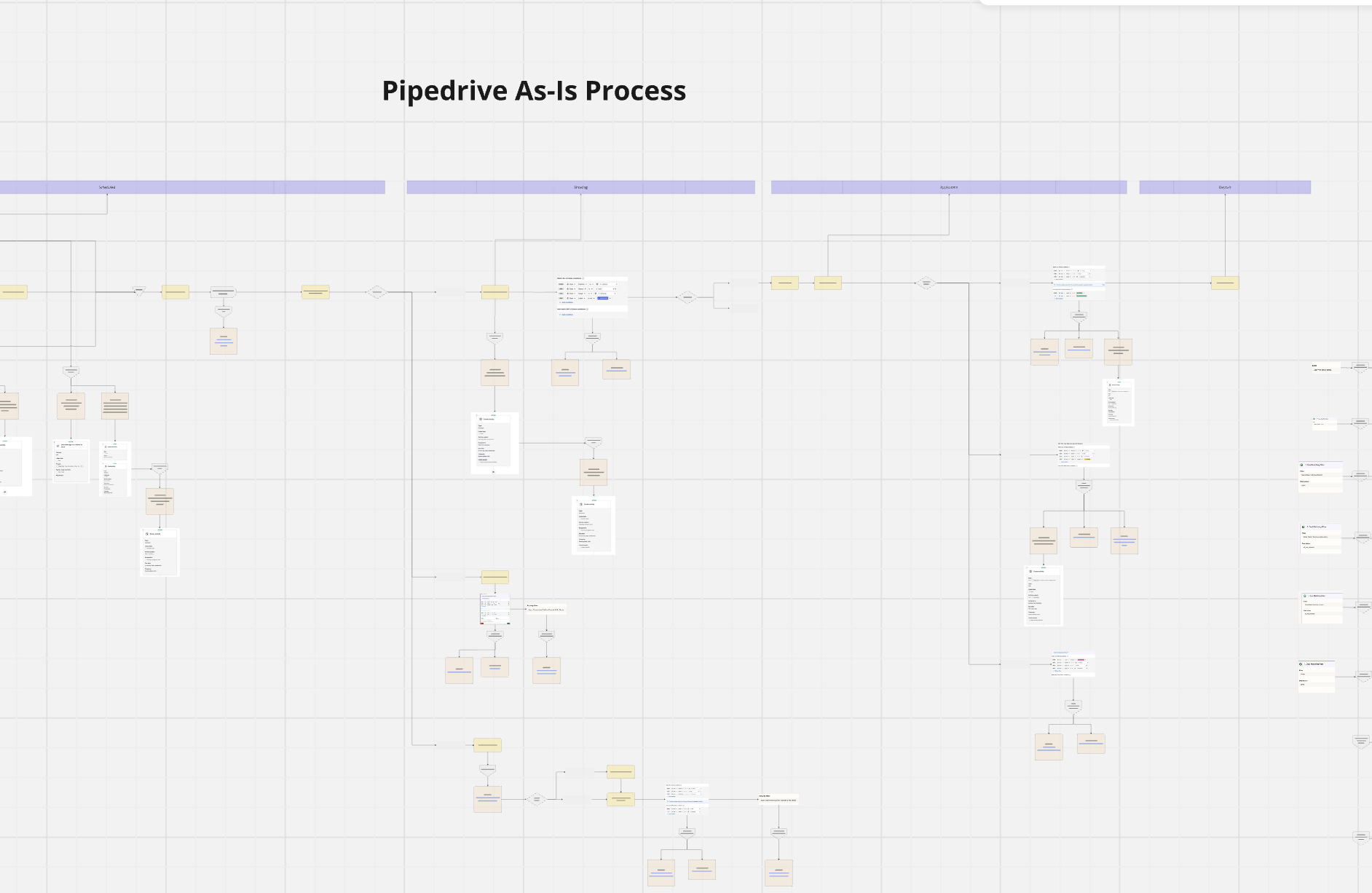
This wasn't a quick audit. The Miro board ended up with over 700 individual elements mapping out the before and after states. That's the level of detail required when you're migrating a business that processes hundreds of leads per month through a multi-stage sales pipeline.
Phase 2: Designing the To-Be
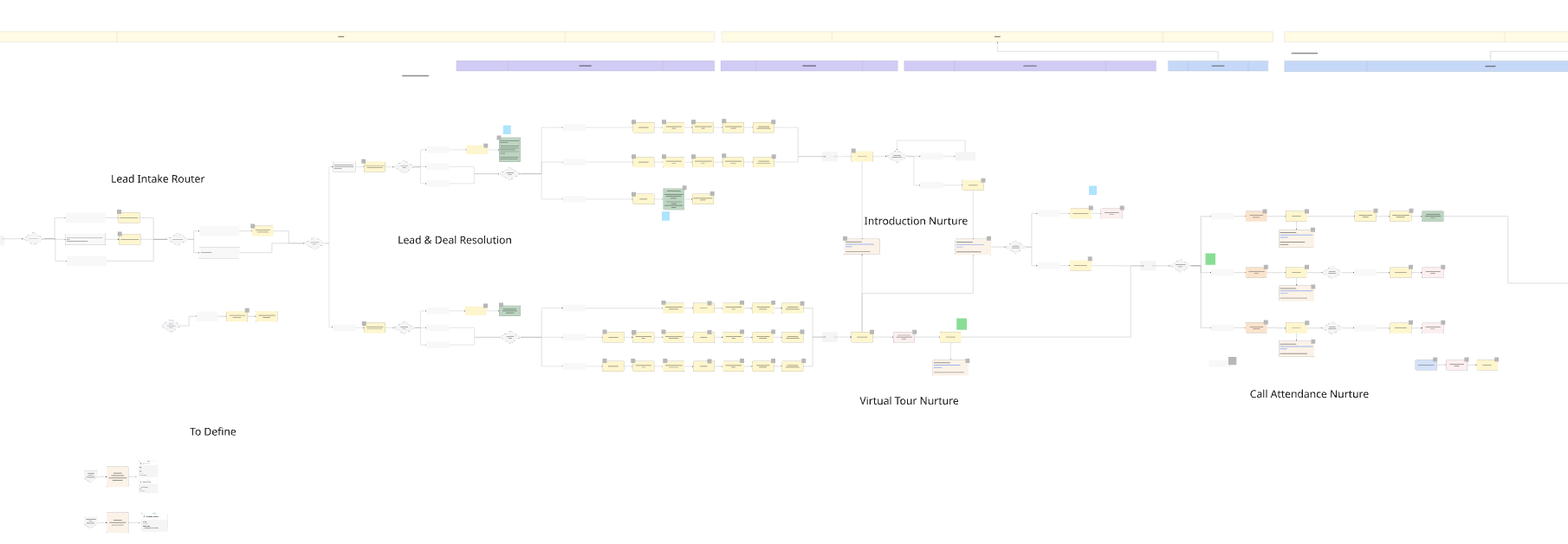
With the existing process fully documented, we designed the HubSpot architecture:
- Lead Pipeline Stages: New Lead, Attempting, Connected, Scheduled, Showing, Application, Deposit, Customer
- Lifecycle Stage Management: Automated routing based on lead source, with dedicated workflows for Virtual Tour Bookings, direct inquiries, and returning leads
- Contact Owner Assignment: Intelligent routing to the right sales rep with fallback to the leasing manager
- Deal Pipeline: Mirroring the lead journey with proper stage-gating and auto-close logic for stale deals
- Attribution Model: Three-layer UTM tracking (Original, Latest, Lead-level, Deal-level) ensuring no attribution data gets overwritten
Phase 3: Build and Go-Live
Travis Page led the HubSpot build, working through weekly review calls with Mario and his operations lead Nicholas Pontacoloni:
- Workflow automation: Auto-close stale deals (7-14 days based on stage), auto-close tasks when deals advance, follow-up task creation for missed actions
- Retargeting integration: 30-day marketing contact window for closed leads before flipping to non-marketing
- Lead scoring: Point-based system using qualifying criteria like budget, stay length, and roommate preferences
- Custom attribution fields: Permanent first-touch attribution fields that lock in Meta/Google ad data, solving the problem of UTMs being overwritten by later organic or direct visits
- Nurture sequences: Targeted HubSpot Sequences triggered by specific lead objections (location, timing, roommates, shared bath)
- Deal Details section: Structured data capture for sales reps to log why leads don't convert, enabling data-driven optimization
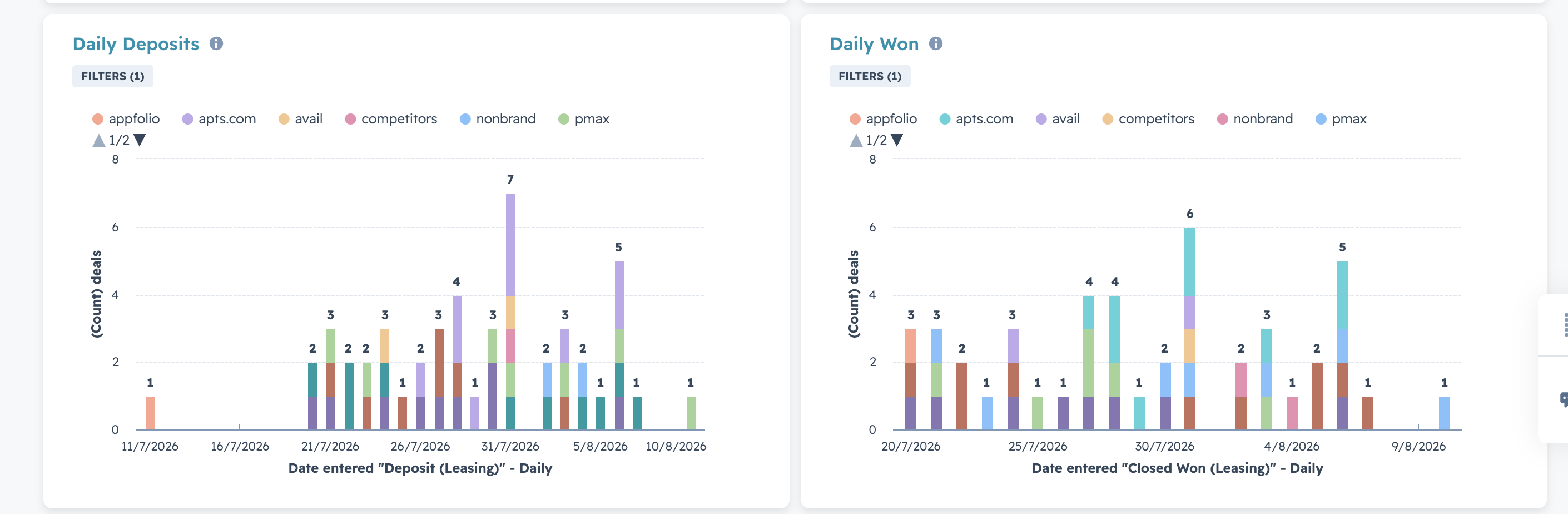
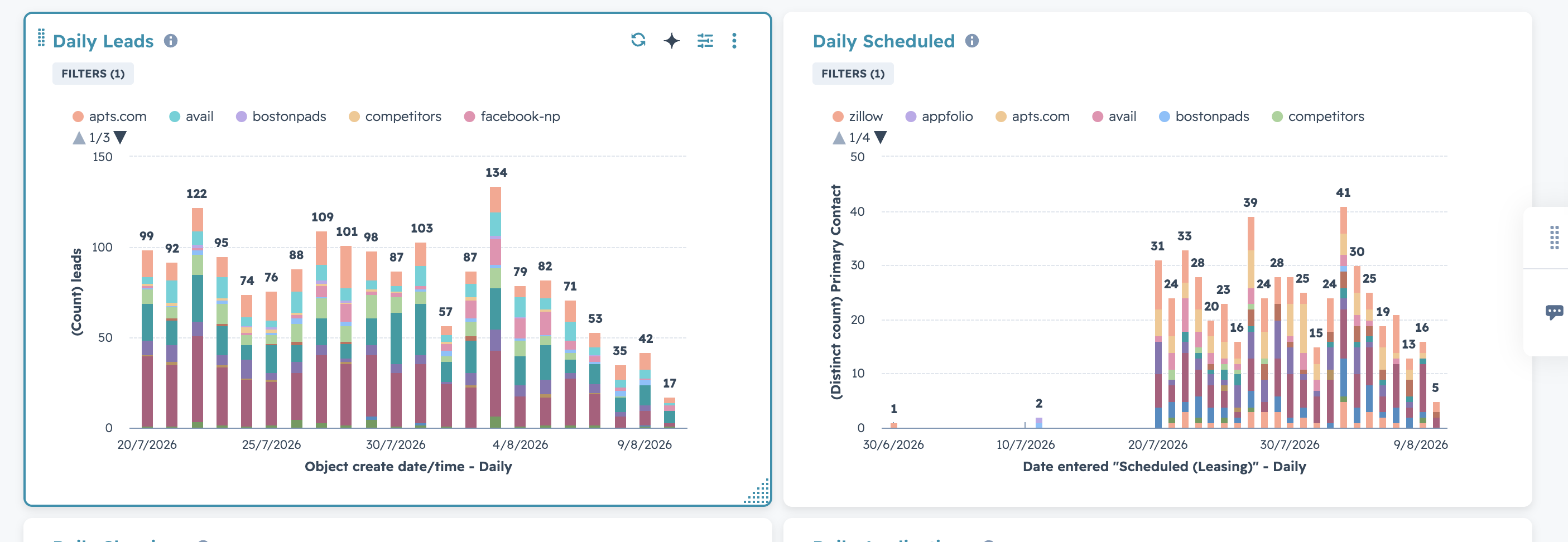
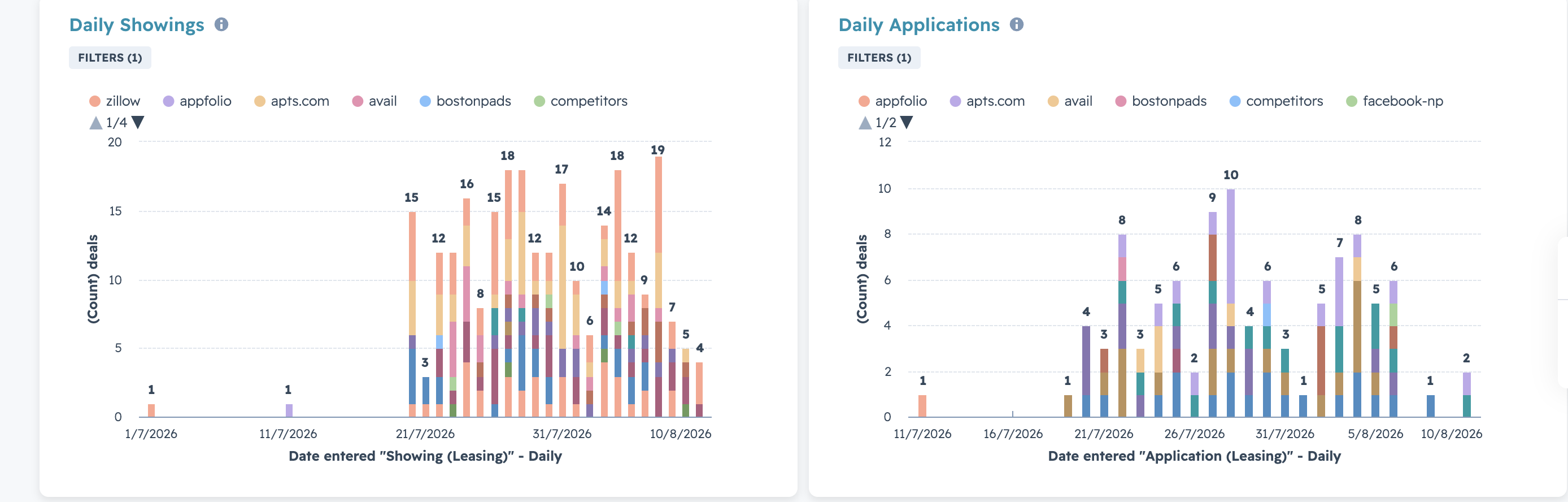
- Agent activity dashboard: Tracking rep task completion to drive performance
The Result
The migration was completed successfully, with RoostUp's team fully transitioned to HubSpot.
Operationally:
- Clean data migration from Pipedrive with all custom fields preserved
- Automated workflows replacing manual processes across the entire sales pipeline
- Structured lead objection tracking enabling targeted nurture sequences
- Auto-close logic keeping the pipeline clean without manual intervention
- Clear attribution across Meta Ads, Google Ads, and organic sources
Growth:
Following the HubSpot migration, RoostUp expanded their engagement with Lock and Quay into paid social. We launched Meta retargeting campaigns using HubSpot audience segments, connected Conversions API (CAPI) for accurate tracking, and began producing UGC video ads with targeted creative briefs.
The first Meta lead came through within days of launch.
Client satisfaction:
Mario Ricciardelli sent an unsolicited reference to a prospective Lock and Quay client:
"I want to send along a glowing reference on my experience with Johnny and his team at Lock and Quay. We just went through a very complex migration to HubSpot which they helped us to execute."
By July 2026, the weekly review calls had evolved from migration check-ins to strategic discussions about scaling operations 10x, building AI-powered deal summaries, and implementing hyper-targeted nurture sequences based on structured lead data.
Key Takeaways
- Deep discovery beats templates. The previous vendor applied automation generically. We mapped 700+ process elements before writing a single workflow.
- Complex operations need a partner, not a vendor. Mario's business runs on sophisticated, interconnected processes. Understanding them was the prerequisite to improving them.
- Migration is a launchpad, not an endpoint. The HubSpot build created the foundation for paid social, lead scoring, and automated nurturing that RoostUp couldn't have done on Pipedrive.
- Attribution is everything. Building custom, locked-in attribution fields from day one meant RoostUp could see exactly which channels drive real revenue.
What We Delivered
Milestone 1: Discovery and Architecture
- As-Is Sales Process mapping (lead to lease, pipeline stages, lifecycle, automation handoffs)
- To-Be Sales Process design (future-state HubSpot architecture)
- Top-level migration strategy (Contacts, Deals, Leads object architecture)
- HubSpot CRM object and property definitions (mapped to Pipedrive equivalents)
- Attribution model design (source-level performance, Lead to Scheduled, Lead to Lease)
- Data migration scope and constraints (active contacts, open deals, key fields vs. archived)
- Third-party tools integration strategy (The Coop, Mailjet, Google Ads, Zapier/Outfunnel)
Milestone 2: Core CRM Build
- Lead Intake Router workflow (multi-source trigger, contact dedup, owner assignment)
- Contact Resolution (deduplication and attribution handling)
- Lead and Deal Resolution (scheduling vs. non-scheduling paths)
- Pipeline stage automation (Lead, Attempting, Connected, Scheduled, Showing, Application, Deposit, Customer)
- Auto-close stale deal logic (7-14 day rules by stage)
- Custom attribution fields (LQ Ad Source, LQ Ad Campaign, LQ Ad ID) locked at first touch
- Agent activity dashboard for rep performance tracking
Milestone 3: Nurture Sequences and Automation
- Introduction to RoostUp email sequence (non-scheduling lead nurture)
- Introduction to RoostUp SMS sequence
- Virtual Tour SMS reminder sequence
- Showing follow-up email and SMS sequence
- No-show follow-up email and SMS sequence
- Canceled follow-up email and SMS sequence
- Application Submission and Qualification workflow
- Application Approval Status handling
- Application approved email and SMS sequence
- Application denied email and SMS sequence
- Application cosigner approved email and SMS sequence
- Application incomplete information email and SMS sequence
- Deposit Status handling
- Won deal alert (Slack and Email)
- Unenrollment logic for all nurture sequences
Milestone 4: Growth Layer (Paid Social)
- Meta Pixel setup and verification
- Conversions API (CAPI) integration via HubSpot
- Retargeting audience builds (Book a Tour, Rebook, Apply Now)
- Meta Ads campaign launch (retargeting with UGC video creatives)
- Creative strategy and storyboarding for in-house content team
Tools and Integrations
HubSpot CRM, Pipedrive (migrated from), Meta Ads, Google Ads, Conversions API (CAPI), The Coop (contact dedup), Mailjet, Miro (process mapping), Notion (project management), Slack (client communication)